
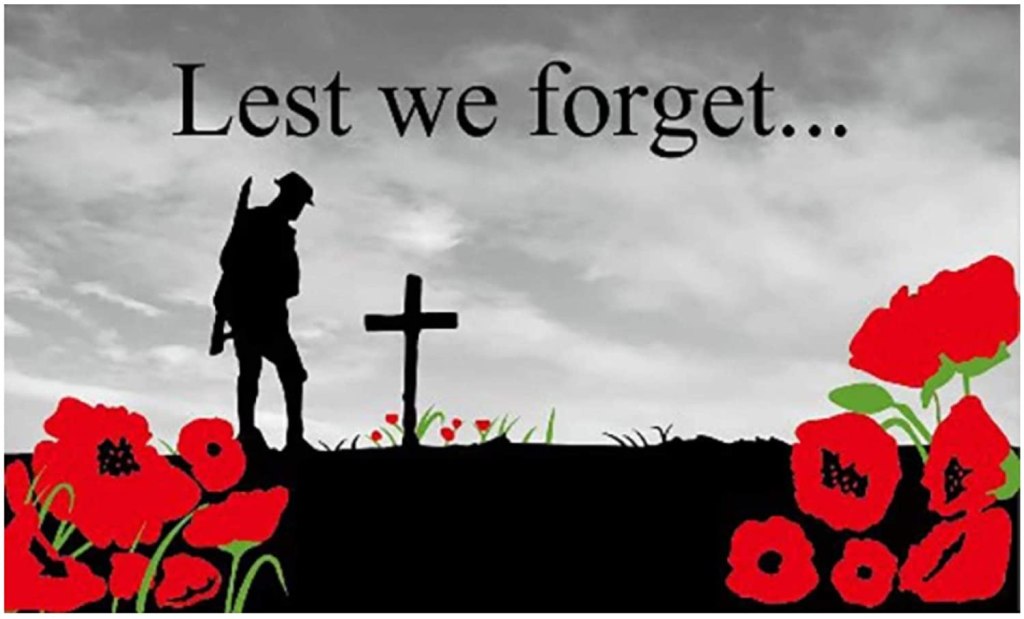
On the 11th of November, 101 years ago, the armistice was signed that ended the Great War on land, sea, and air. A year later, in 1919, King George V8* of Britain inaugurated Remembrance Day to honor the lives of members of the armed forces who died in WWI**. It is observed in Commonwealth member states for servicemen and women who died in the line of duty.
Veterans’ Day *** is also observed on this day in the US to honor all military veterans, living and passed, who have served their country.
In Europe****, Britain, and the Commonwealth countries, it is common to observe two minutes of silence at 11 a.m. every November 11.
Key Facts & Information
*Born on June 3, 1865, George V was the King of Great Britain between 1910 and 1936. He ascended the throne after the sudden death of his brother Albert.
EARLY AND PERSONAL LIFE
- George Frederick Ernest Albert of the House of Saxe-Coburg-Gotha was the second son of Edward VII and Alexandra of Denmark. He was the grandson of Queen Victoria and Prince Albert.
- Together with his older brother, Albert, George was educated by private tutors. Later, he joined the Royal Navy, while Albert left for Trinity College.
- In 1892, Albert unexpectedly died of influenza. As a result, Prince George assumed the role as heir to the throne. He was named the Duke of York and became a member of the House of Lords.
- After the death of his brother, George married Princess Mary of Teck, Albert’s former fiancée, and had six children: Prince Edward, Prince Albert, Princess Mary, Prince Henry, Prince George, and Prince John.
- In January 1901, following the death of Queen Victoria, Prince George became the first to swear his allegiance to his father, the new king.
- In May of the same year, Prince George opened the first Parliament of the new Commonwealth of Australia. He also visited New Zealand, South Africa, and Canada.
- By November, King Edward VII made him the Prince of Wales. He then continued with the Royal Tours, flying to Berlin, Austria, India, and Burma.
AS KING OF GREAT BRITAIN
- On May 6, 1910, following the death of his father, Edward VII, George V was crowned as King of Great Britain.
- As the new king, George V faced budget controversy and constitutional crisis in Britain. His initial action gave the House of Lords assumptions that he favored the middle class over the gentry.
- In July 1914, the First World War broke out. As king, he visited military hospitals and the front.
- Together with Queen Mary, George V became the only monarch to visit India as King-Emperor in 1911.
- Aside from military efforts, George V also faced anti-German sentiment in Britain. Given his obvious German lineage, the king chose to change his name from the House of Saxe-Coburg-Gotha to the House of Windsor.
- George V also decided to distance himself from his cousin, Tsar Nicholas II, when the Bolshevik revolution broke out. He denied the tsar and his family political asylum.
- Given his actions, George V was one of the few European monarchs who remained in power and did not fall to any civil war or revolution.
- In 1916, the rebellion in Ireland led to an independent Irish Parliament. Moreover, the dominions of Canada, New Zealand, Australia, and South Africa began to clamour for self-governance, which led to the formation of the Commonwealth of Nations in 1931. India soon followed in 1935.
- In 1931, the Statute of Westminster was enacted, which enabled the Dominion Parliaments to pass laws without reference to the laws of the Mother country. Amidst such independence, the dominion maintained its allegiance to the Crown.
- In 1932, King George V began the tradition of the annual Christmas Broadcast to the Empire.
LATER LIFE AND LEGACY
- George V was the first King of Great Britain from the House of Windsor. With his deteriorating health in 1935, his relationship with his eldest son also went awry. Prince Edward, who was expected to be king, failed to do his duties when he had an affair with a married woman.
- The same year, he celebrated his Silver Jubilee. As king, he gained the respect of his people after being visible during the First World War.
- King George V chose his second son, Prince Albert, to later be crowned as King George VI, father of future Queen Elizabeth II.
- Key among his legacy was when he secured a strong government during the collapse of the pound and the crisis in the Labour administration in 1931. He persuaded his cabinet, conservative, and liberal ministers to form a national coalition government.
World War I (WW1)**
World War I (WW1) also known as the First World War, was a global war centered in Europe that began on 28th July 1914 and lasted until 11th November 1918. The war lasted exactly four years, three months and 14 days. Before World War II began in 1939, World War I was called the Great War, the World War or the War to End all Wars. 135 countries took part in World War I, and more than 15 million people died. See the fact file below for more information about World War I.
World War 1 was a military conflict lasting from 1914 to 1918 which involved nearly all the biggest powers of the world. It involved two opposing alliances – the Allies and the Central Powers. The countries of the Allies included Russia, France, British Empire, Italy, United States, Japan, Rumania, Serbia, Belgium, Greece, Portugal and Montenegro. The countries of the Central Powers included Germany, Austria-Hungary, Turkey and Bulgaria.
The WW1 facts listed on this page are amazing and very interesting when you consider that the events happened in very recent history.
WW1 Facts for Kids
- World War I triggered on June 28, 1914. World War 1 was triggered on 28 June 1914 by the assassination of the Archduke Franz Ferdinand of Austria and his pregnant wife Sophie. Archduke Franz Ferdinand of Austria was the nephew of Emperor Franz Josef and heir to the throne of Austria and Hungary. The assassination was planned by a Serbian terrorist group, called The Black Hand and the man who shot Franz Ferdinand and his wife was a Bosnian revolutionary named Gavrilo Princip.
- A primary cause of WW1 was a difference over foreign policy. Although the assassination of Franz Ferdinand triggered WW1, that was only the immediate cause. Differences over foreign policy between the major world powers was the underlying cause of the war.
- WW1 had many causes:
- A tangle of alliances made between countries, to maintain a balance power in Europe, which brought about the scale of the conflict.
- The Bosnian Crisis where Austria-Hungary took over the former Turkish province of Bosnia in 1909 angering Serbia.
- Countries were building their military forces, arms and battleships.
- Countries wanted to regain lost territories from previous conflicts and build empires.
- The Moroccan Crisis where Germans were protesting in 1911 against the French possession of Morocco.
- World War I was known by a number of different names. Other names for World War 1 include ‘The War to End All Wars’, The War of the Nations, WW1 and ‘The Great War’.
- The Americans joined World War 1 after 128 Americans were killed by a German submarine. In 1915, the British passenger sip Lusitania was sunk by a German submarine. In all, 1,195 passengers, including 128 Americans, lost their lives. Americans were outraged and put pressure on the U.S. government to enter the war. President Woodrow Wilson wanted a peaceful end to the war, but in 1917, when the Germans announced that their submarines would sink any ship that approached Britain, Wilson declared that America would enter the war and restore peace to Europe. The United States entered the war on April 6, 1917.
- 8 million soldiers died in WW1 and 21 million were injured. 65 million troops were mobilized during during the war, 8 million troops died and 21 million troops were wounded. 58,000 British soldiers were lost on the first day at the Battle of the Somme. Chemical weapons were first used in World War I. The chemical was mustard gas.
- The United States only spent seven and a half months in actual combat. The U.S. was in the war in actual combat for only seven and a half months during which time 116,000 were killed and 204,000 were wounded. In the Battle of Verdun in 1916, there were over a million casualties in ten months.
- By 1918, German citizens were striking and demonstrating against the war. The British navy blocked German ports, which meant that thousands of Germans were starving and the economy was collapsing. Then the German navy suffered a major mutiny. After German Emperor Kaiser Wilhelm II abdicated on November 9th, 1918, the leaders of both sides met at Compiegne, France. The peace armistice was signed on November 11th. By the end of the war four empires — the Russian empire, the Ottoman empire, the German empire, and the Austro-Hungarian empire had collapsed because of the war.
- In 1919, The Treaty of Versailles officially ended the WW1. The Treaty required that Germany accept full responsibility for causing the war; make reparations to some Allied countries; surrender some of its territory to surrounding countries; surrender its African colonies; and limit the size of its military. The Treaty also established the League of Nations to prevent future wars. The League of Nations helped Europe rebuild and fifty-three nations joined by 1923. But the U.S. Senate refused to let the United States join the League of Nations, and as a result, President Wilson, who had established the League, suffered a nervous collapse and spent the rest of his term as an invalid.
- Germany joined the League of Nations in 1926, but many Germans were very resentful of the Treaty of Versailles. Germany and Japan withdrew from the League of Nations in 1933. Italy withdrew three years later. The League of Nations was unable to stop German, Italian, and Japanese from expanding their power and taking over smaller countries. Many believe World War I never really ended, and that World War II never would have happened if not for WW1.
Veterans’ Day***
Veterans’ Day is observed on November 11 when uk and Americans honor all living military veterans, including the many working moms who are veterans of military service. The day is celebrated with speeches and parades across the country.
For more facts on Veterans’ Day, see the file below or alternatively you can download our huge 22 worksheet study pack to utilise within the classroom or home environment.
- Veterans’ Day is always observed on November 11.
- On Veterans’ Day, Americans honor all living military veterans, including the many working moms who are veterans of military service.
- Veterans’ Day is celebrated with speeches and parades across the U.S.
- The holiday began as Armistice Day on Nov. 11, 1919, the first anniversary of the end of World War I.
- In 1926, Congress passed a resolution for an annual observance.
- In 1938, Nov. 11 became a national holiday.
- In 1954, President Dwight D. Eisenhower signed legislation changing the name to Veterans’ Day in order to honor veterans of all American wars.
- On November 11, 1921, an unidentified American soldier killed in the war was buried at Arlington National Cemetery in Washington, D.C. It is called the Tomb of the Unknown Soldier. An official wreath-laying ceremony is held each Veterans’ Day at the Tomb of the Unknown Soldier in Arlington National Cemetery. Usually the president, or another high-ranking government official, lays the wreath on the grave.
- Britain, France, Australia and Canada also commemorate the veterans of World Wars I and II on or near November 11th. Canada has Remembrance Day, while Britain has Remembrance Sunday (the second Sunday of November). In Europe, Britain and the Commonwealth countries it is common to observe two minutes of silence at 11 a.m. every November 11.
- Veterans’ Day should not be confused with Memorial Day. According to the U.S. Department of Veterans Affairs, “Memorial Day (the fourth Monday in May) honors American service members who died in service to their country or as a result of injuries incurred during battle, while Veterans Day pays tribute to all American veterans–living or dead–but especially gives thanks to living veterans who served their country honorably during war or peacetime.”
Europe (Continent)****
Europe is the second smallest continent in the world. It only has a land area of 4 million square miles. Many of the most prominent empires were established on this continent such as British, Roman, Russian, and Spanish Empires.
Key Facts & Information
Etymology and Background
- The name of the continent originated from the Greek word “eurus”, which means wide. There are other theories on where the origin of the word Europe came from. One of them is that it came from the Ancient Syrian word “ereb”, which means sunset.
- There are over 250 different languages spoken throughout this continent.
- This continent is a part of Eurasia, a massive continental landmass that is composed of Europe and some parts of Asia.
- Eurasia has both the largest and smallest country in the world.
- Europe played a significant part in history, especially in the Renaissance period and the Industrial Revolution.
- The largest country in the world (Russia) can be partly found on this continent. Russia is both a part of Europe and Asia.
- The smallest country in the world, Vatican City, can also be found on this continent.
- The current population of Europe is approximately 740 million people, which comprises 12% percent of the global population.
- Hecataeus and Anaximander were the first people to use the word Europe as a term in geography.
- The continent is made up of 50 countries, and 28 of those are a part of the European Union.
- The largest city in Europe is Moscow, which is located in the largest country in the world, Russia.
- The largest island in the world is Greenland which is closer to North America than Europe.
- The longest river in Europe can also be found in Russia and is called the Volga River which is 3,692 meters in length.
- The highest mountain in Europe is also located in Russia. It is called Mount Elbrus which is 5,642 meters high.
- The most widespread religion on the continent is Christianity, which is followed by 76% of Europe’s population.
- The city with the highest number of people is Istanbul, which is located in Turkey. It has a population of 14.5 million people.
- Nuuk, which is the capital city of Greenland, has the least-densest population in the world.
- This is the continent with the highest Gross Domestic Product.
- In 2017, Norway was named as the country with the happiest people.
- 44 percent of the wine that is produced globally comes from this continent.
- There are 18 countries that use the same currency, which is the Euro.
- Great Britain was the starting point of the Industrial Revolution.
- There was a theory that the Mediterranean Sea was a desert in ancient times.
- A lot of the world’s most influential leaders came from Europe, such as Napoleon Bonaparte and Adolf Hitler.
- On November 1, 1755, an earthquake occurred in Lisbon, Portugal which killed thousands of people.
- This continent also has the highest toilet in the world, which can be found at the top of Mont Blanc at an elevation of 13,780 feet.
- The world’s longest name for a town can also be found in this continent. It’s called Lanfairpwllgwyngyllgogerychwyrndrobwllllantsyiliogo, which is found in Wales.
- The start of World War I happened in this continent when Archduke Franz Ferdinand was assassinated in Sarajevo on June 28, 1914.
- Bonanno Pisano is the one responsible for the architecture of the Leaning Tower of Pisa.
- World War II was started by Germany when it attacked Poland.
- The famous Colosseum in Rome was built by Emperor Vespasian, the founder of the Flavian dynasty. He was also the last in the “Year of the Four Emperors”.
- The largest producer of bananas in Europe is Spain.
- The tower in which Big Ben is located is called the Elizabeth Tower.
- Georgia is where the oldest hominid in Europe was found. It is said to be almost 2 million years old.
- Parthenon, which can be found in Greece, is said to have been built for their patron Athena. The construction of the ancient temple started in 447 B.C.
- The Old St. Peter’s Basilica was built by the initiatives of Roman Emperor Constantine I. It was reconstructed in the 15th century. This is also where the tomb of St. Peter is located.
- In the 15th century, Spain and Portugal were the greatest naval powers. They were known for their many exploration feats during that time.
- This continent is also where a lot of great leaders emerged, such as Napoleon Bonaparte, who led many successful battles during the French Revolution.
Remembrance Day*****
- The name of the continent originated from the Greek word “eurus”, which means wide. There are other theories on where the origin of the word Europe came from. One of them is that it came from the Ancient Syrian word “ereb”, which means sunset.
- There are over 250 different languages spoken throughout this continent.
- This continent is a part of Eurasia, a massive continental landmass that is composed of Europe and some parts of Asia.
- Eurasia has both the largest and smallest country in the world.
- Europe played a significant part in history, especially in the Renaissance period and the Industrial Revolution.
- The largest country in the world (Russia) can be partly found on this continent. Russia is both a part of Europe and Asia.
- The smallest country in the world, Vatican City, can also be found on this continent.
- The current population of Europe is approximately 740 million people, which comprises 12% percent of the global population.
- Hecataeus and Anaximander were the first people to use the word Europe as a term in geography.
- The continent is made up of 50 countries, and 28 of those are a part of the European Union.
- The largest city in Europe is Moscow, which is located in the largest country in the world, Russia.
- The largest island in the world is Greenland which is closer to North America than Europe.
- The longest river in Europe can also be found in Russia and is called the Volga River which is 3,692 meters in length.
- The highest mountain in Europe is also located in Russia. It is called Mount Elbrus which is 5,642 meters high.
- The most widespread religion on the continent is Christianity, which is followed by 76% of Europe’s population.
- The city with the highest number of people is Istanbul, which is located in Turkey. It has a population of 14.5 million people.
- Nuuk, which is the capital city of Greenland, has the least-densest population in the world.
- This is the continent with the highest Gross Domestic Product.
- In 2017, Norway was named as the country with the happiest people.
- 44 percent of the wine that is produced globally comes from this continent.
- There are 18 countries that use the same currency, which is the Euro.
- Great Britain was the starting point of the Industrial Revolution.
- There was a theory that the Mediterranean Sea was a desert in ancient times.
- A lot of the world’s most influential leaders came from Europe, such as Napoleon Bonaparte and Adolf Hitler.
- On November 1, 1755, an earthquake occurred in Lisbon, Portugal which killed thousands of people.
- This continent also has the highest toilet in the world, which can be found at the top of Mont Blanc at an elevation of 13,780 feet.
- The world’s longest name for a town can also be found in this continent. It’s called Lanfairpwllgwyngyllgogerychwyrndrobwllllantsyiliogo, which is found in Wales.
- The start of World War I happened in this continent when Archduke Franz Ferdinand was assassinated in Sarajevo on June 28, 1914.
- Bonanno Pisano is the one responsible for the architecture of the Leaning Tower of Pisa.
- World War II was started by Germany when it attacked Poland.
- The famous Colosseum in Rome was built by Emperor Vespasian, the founder of the Flavian dynasty. He was also the last in the “Year of the Four Emperors”.
- The largest producer of bananas in Europe is Spain.
- The tower in which Big Ben is located is called the Elizabeth Tower.
- Georgia is where the oldest hominid in Europe was found. It is said to be almost 2 million years old.
- Parthenon, which can be found in Greece, is said to have been built for their patron Athena. The construction of the ancient temple started in 447 B.C.
- The Old St. Peter’s Basilica was built by the initiatives of Roman Emperor Constantine I. It was reconstructed in the 15th century. This is also where the tomb of St. Peter is located.
- In the 15th century, Spain and Portugal were the greatest naval powers. They were known for their many exploration feats during that time.
- This continent is also where a lot of great leaders emerged, such as Napoleon Bonaparte, who led many successful battles during the French Revolution.
 ukhomeschool