
The next full Moon will occur on Monday, November 30, 2020, at 4:30 AM ET, and is known as the Full Beaver Moon.
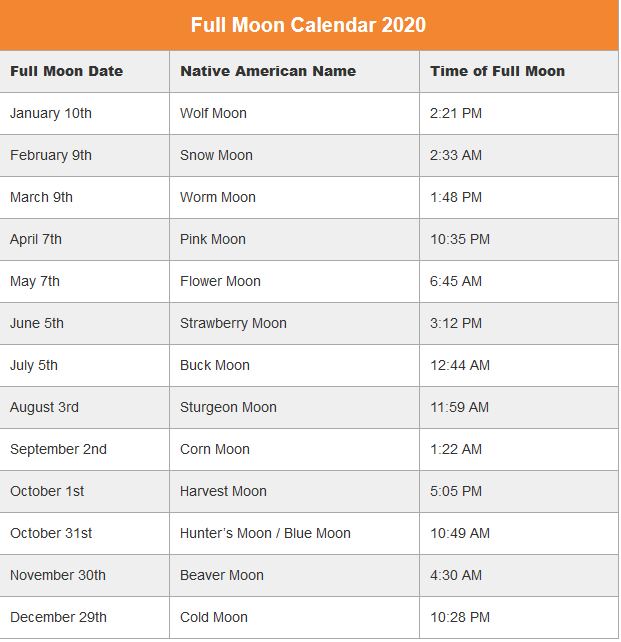
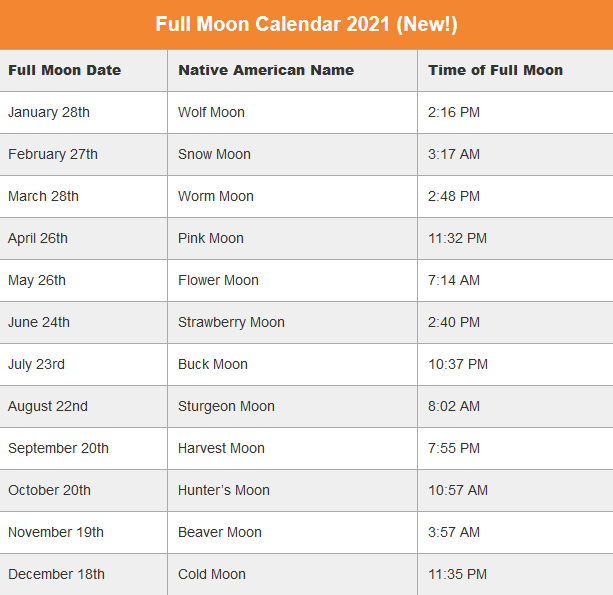
Full Moon names date back to Native Americans of North America. Tribes kept track of the seasons by giving distinctive names to each recurring full Moon. Full Moon names were applied to the entire month in which each occurred.
There was some variation in the full Moon names, but in general, the same ones were consistent among regional tribes. European settlers followed that custom and created some of their own names.

Full Wolf Moon – January Amid the cold and deep snows of midwinter, the wolf packs howled hungrily outside Indian villages. Thus, the name for January’s full Moon.
Sometimes it was also referred to as the Old Moon, or the Moon After Yule. Some called it the Full Snow Moon, but most tribes applied that name to the next Moon.
The Full Sap Moon, marking the time of tapping maple trees, is another variation. To the settlers, it was also known as the Lenten Moon, and was considered to be the last full Moon of winter.

– Full Pink Moon – April This name came from the herb moss pink, or wild ground phlox, which is one of the earliest widespread flowers of the spring. Other names for this month’s celestial body include the Full Sprouting Grass Moon, the Egg Moon, and among coastal tribes the Full Fish Moon, because this was the time that the shad swam upstream to spawn.



– The Full Buck Moon – July July is normally the month when the new antlers of buck deer push out of their foreheads in coatings of velvety fur. It was also often called the Full Thunder Moon, for the reason that thunderstorms are most frequent during this time. Another name for this month’s Moon was the Full Hay Moon.

–Full Sturgeon Moon – August The fishing tribes are given credit for the naming of this Moon, since sturgeon, a large fish of the Great Lakes and other major bodies of water, were most readily caught during this month. A few tribes knew it as the Full Red Moon because, as the Moon rises, it appears reddish through any sultry haze. It was also called the Green Corn Moon or Grain Moon.

– Full Corn Moon or Full Harvest Moon – September This full Moon name is attributed to Native Americans because it marked when corn was supposed to be harvested. Most often, the September full Moon is actually the Harvest Moon, which is the full Moon that occurs closest to the fall equinox.
In two years out of three, the Harvest Moon comes in September, but in some years it occurs in October. At the peak of harvest, farmers can work late into the night by the light of this Moon.
Usually the full Moon rises an average of 50 minutes later each night, but for the few nights around the Harvest Moon, the Moon seems to rise at nearly the same time each night: just 25 to 30 minutes later across the U.S., and only 10 to 20 minutes later for much of Canada and Europe.
Corn, pumpkins, squash, beans, and wild rice the chief Indian staples are now ready for gathering.
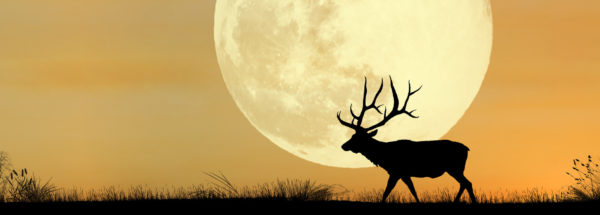
– Full Hunter’s Moon or Full Harvest Moon – October This full Moon is often referred to as the Full Hunter’s Moon, Blood Moon, or Sanguine Moon. Many moons ago, Native Americans named this bright Moon for obvious reasons. The leaves are falling from trees, the deer are fattened, and it’s time to begin storing up meat for the long winter ahead.
Because the fields were traditionally reaped in late September or early October, hunters could easily see fox and other animals that come out to glean from the fallen grains. Probably because of the threat of winter looming close, the Hunter’s Moon is generally accorded with special honor, historically serving as an important feast day in both Western Europe and among many Native American tribes
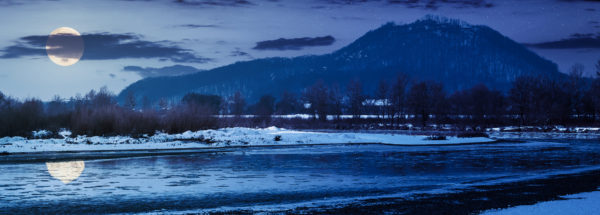

The term Long Night’s Moon is a doubly appropriate name because the midwinter night is indeed long, and because the Moon is above the horizon for a long time. The midwinter full Moon has a high trajectory across the sky because it is opposite a low Sun.
 ukhomeschool