
Shrove Tuesday is an important day in the Christian religion, which takes place the day before Ash Wednesday, the first day of Lent. Shrove Tuesday always falls 47 days before Easter Sunday, so the date varies from year to year and falls between February 3 and March 9.
The name of the day derives from the English word ‘shrive’ which means to repent for your sins through confession. This idea is crucial to Shrove Tuesday as Lent is a time for Christians to reflect on their life and confess to any sins.
But, you might be wondering, what does that have to do with pancakes? Traditionally, Shrove Tuesday was the last opportunity to use up eggs and fats before embarking on the fast for Lent. Making pancakes is a simple and tasty way to use up all of these ingredients!
Now, it is more common in England to hear the day referred to as Pancake Day rather than Shrove Tuesday. But for Christians, the day still holds a special meaning and signals the beginning of Lent.
Did you know that, in 1961, Shrove Tuesday was on the 14th of February; the same day as Valentine’s Day! This phenomenon is not set to occur again until 2040!
How is Pancake Day/ Shrove Tuesday celebrated around the world?
On Pancake Day, there are many different towns and villages across the UK that host “pancake races”. This tradition is said to have originated in 1445, when a woman who was cooking pancakes lost track of the time and had to leave for church while still carrying her frying pan, even going as far as still flipping the pancake so it didn’t burn! Impressive, right?
This tradition is not only popular in the UK however, as since 1950, the people of Liberal, Kansas have competed with the people of Olney in the UK in pancake races! You might ask; how do they do that when they’re on opposite sides of the world? Well, they run their own courses and then compare finishing times afterwards! As of 2020, Liberal have 39 wins and Olney have 29!
When the tradition of making pancakes on Shrove Tuesday spread throughout Europe, people in France followed the trend. They made waffles, crepes and a dessert many know as king cake to utilize their dairy products. They called it “Mardi Gras” which translates to Fat Tuesday!
In Germany, Shrove Tuesday is referred to as “Fastnachtsdienstag” and is celebrated by having a school holiday and wearing fancy dress. While in Portuguese, Spanish and Italian speaking countries, Shrove Tuesday is known as Carnival. This is also celebrated through fancy dress, as well as extravagant street parades. In Spain, Carnival is also called “Día de la Tortilla” which translates to Omelette Day.
Did you know that Brazil’s famous Carnival in Rio de Janeiro is an example of a Shrove Tuesday celebration?
What are pancakes?
A pancake is a thin, flat cake, made of batter and fried in a frying pan. A traditional English pancake is very thin and is served immediately. Golden syrup or lemon juice and caster sugar are the usual toppings for pancakes.
How to make some simple pancakes
To make some simple pancakes, all you need are 100g flour, 2 eggs, 300ml of milk and a splash of vegetable oil. Simply whisk the ingredients together into a smooth batter before cooking your pancakes for 1 minute on each side until golden. Serve with a tasty topping such as chocolate spread or lemon and sugar.
What is Lent?
Lent is a period of 40 days where Christians remember the events leading up to and including the death of Jesus Christ, who Christians believe is the Son of God and whose life and teachings are the foundation of Christianity.
A lot of people use Lent as a way of testing their willpower – often giving up things like chocolate or other sweet treats before Easter.
Millions of people do this as a sign of sacrifice, and Christians do it to represent Jesus Christ’s sacrifice when he went into the desert to pray and fast for the 40 days before later dying on the cross.
According to the Bible, Jesus then came back to life on Easter Sunday. This is the most important day in the Christian calendar.
Pancake Day activities for kids
- Pancake Treasure Hunt. Cut out some paper pancakes and hide them round the house and garden (like an Easter egg hunt). …
- Pancake Balancing. …
- Blow the Pancake. …
- Flap the Pancake.
Cardboard Pancakes
There’s something very satisfying about a stack of pancakes, but little hands might enjoy playing, stacking and counting pancakes if they’re made from cardboard rather than greasy batter. Corrugated card pancakes are easy to make and can be used in a number of Shrove Tuesday-themed games:
- FLIPPING FUN – Pop your cardboard pancakes into a clean pan to help children practice their flipping skills minus the mess. Kid’s kitchen play sets usually contain pans if your little ones aren’t strong enough to wield the real thing.
- MEMORY GAME – Pair up your pancakes and on each pair draw a different topping, strawberries, banana and chocolate chips are good ones but your little crafters will be able to think of more. Then flip your pairs over and mix them up to create a simple memory game where the players have to find the matching pairs. Younger children may struggle with more than 4 or 5 pairs but older children will enjoy more of a challenge, so up the number of pancake pairs accordingly.
- PANCAKE HUNT – Create a pancake treasure hunt around the house. To prepare make sure your kids are distracted and go from room to room hiding pancakes in crafty places. You can make the hiding places trickier or easier to find depending on the age of the players.
- PANCAKE BALANCE – Put a cardboard pancake on your child’s head and challenge them to walk across the room. If they make it add another pancake to the stack. If they’re struggling make the distance a bit shorter. And if you’ve got more than one child to entertain then set them up in a race against each other!
- PANCAKE TOSS – Pop a frying pan on the floor and arm your children with cardboard pancakes. Their job is to drop or toss as many pancakes into the pan as they can. Depending on how old they are, they could either stand directly over the pan or a few metres away.
For older children
There are a number of traditional games associated with Pancake Day, but since they involve real pancakes and real pans they’re best for older children or perhaps fun-loving adults.
- PANCAKE RACE – Set the length of the race track and give the racers a pan containing a pancake. They then have to make it to the finish line first, without their pancakes slipping out. Any contestant who drops their pancake has to return to the starting line.
- PANCAKE TOSS CHALLENGE – As above, each contestant must have a pancake and a pan. You then set a timer for one minute and the contestants have to flip their pancakes as many times as they can before the buzzer. This one is much trickier than it sounds!
Ingredients
For the pancake mixture
- 110g/4oz plain flour, sifted
- pinch of salt
- 2 eggs
- 200ml/7fl oz milk mixed with 75ml/3fl oz water
- 50g/2oz butter
To serve
- caster sugar
- lemon juice
- lemon wedges
Method
- Sift the flour and salt into a large mixing bowl with a sieve held high above the bowl so the flour gets an airing. Now make a well in the center of the flour and break the eggs into it. Then begin whisking the eggs – any sort of whisk or even a fork will do – incorporating any bits of flour from around the edge of the bowl as you do so.
- Next gradually add small quantities of the milk and water mixture, still whisking (don’t worry about any lumps as they will eventually disappear as you whisk). When all the liquid has been added, use a rubber spatula to scrape any elusive bits of flour from around the edge into the center, then whisk once more until the batter is smooth, with the consistency of thin cream. Now melt the 50g/2oz of butter in a pan. Spoon 2 tbsp of it into the batter and whisk it in, then pour the rest into a bowl and use it to lubricate the pan, using a wodge of kitchen paper to smear it round before you make each pancake.
- Now get the pan really hot, then turn the heat down to medium and, to start with, do a test pancake to see if you’re using the correct amount of batter. I find 2 tbsp is about right for an 18cm/7in pan. It’s also helpful if you spoon the batter into a ladle so it can be poured into the hot pan in one go. As soon as the batter hits the hot pan, tip it around from side to side to get the base evenly coated with batter. It should take only half a minute or so to cook; you can lift the edge with a palette knife to see if it’s tinged gold as it should be. Flip the pancake over with a pan slice or palette knife – the other side will need a few seconds only – then simply slide it out of the pan onto a plate.
- Stack the pancakes as you make them between sheets of grease proof paper on a plate fitted over simmering water, to keep them warm while you make the rest.
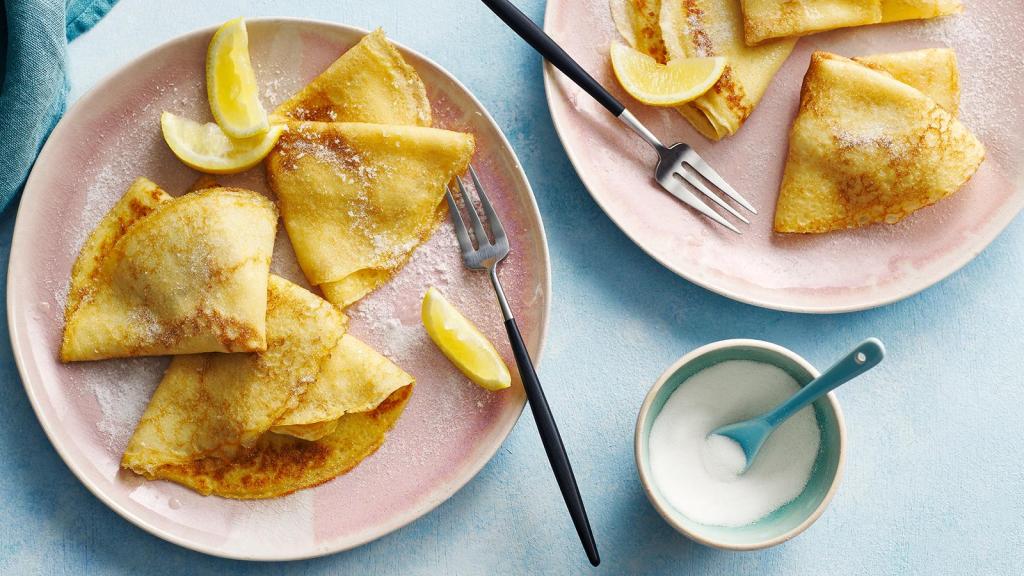
- To serve, sprinkle each pancake with freshly squeezed lemon juice and caster sugar, fold in half, then in half again to form triangles, or else simply roll them up. Serve sprinkled with a little more sugar and lemon juice and extra sections of lemon.
 ukhomeschool