
https://en.wikipedia.org/wiki/Joseph_Merrick
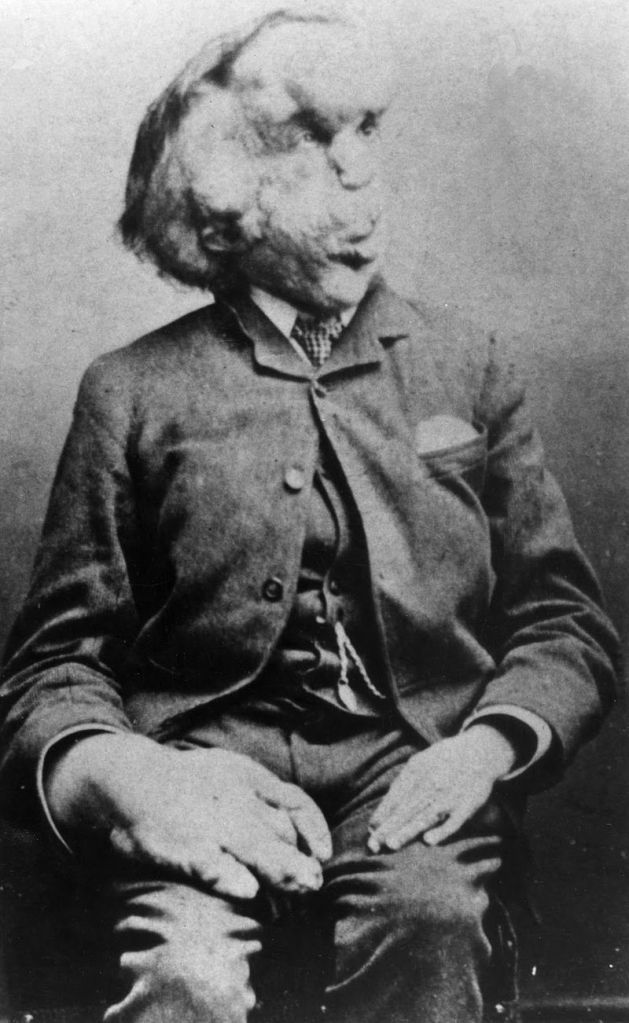
5 August 1862 – 11 April 1890
Joseph Merrick, in full Joseph Carey Merrick, also called the Elephant Man, (born August 5, 1862, Leicester, Leicestershire, England—died April 11, 1890, London), disfigured man who, after a brief career as a professional “freak,” became a patient of London Hospital from 1886 until his death.
He came to be known as the Elephant Man due to the skin on his face. His facial deformities led people to see Merrick as a “monster” and a threat to society. … Merrick’s remains were buried on April 24, 1890.
Merrick’s death was ruled accidental and the certified cause of death was asphyxia, caused by the weight of his head as he lay down. Treves, who performed an autopsy, said Merrick had died of a dislocated neck.
Only a few hundred people in the world have Proteus syndrome, a bizarre condition in which a mutant gene causes asymmetrical growth of body parts. The syndrome can be horribly disfiguring, as you can see in this illustration of Joseph Merrick, the 19th Century Englishman who became known as the Elephant Man.
In 1884, Merrick decided to try to profit from his deformities and escape life in the workhouse. … His body was covered with tumors, and his legs and hip were so deformed that he had to walk with a cane.
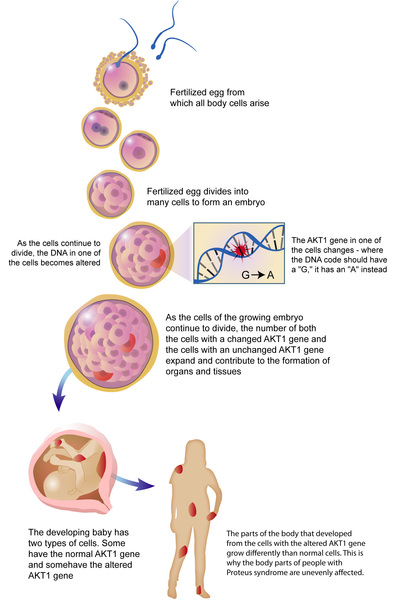
Proteus syndrome results from a mutation in the AKT1 gene. This genetic change is not inherited from a parent; it arises randomly in one cell during the early stages of development before birth. As cells continue to grow and divide, some cells will have the mutation and other cells will not.
Merrick died on April 11, 1890, at age 27. His skeleton is kept at Queen Mary University of London, where students and medical faculty members can request to view it, but the burial location of his soft tissue remains were a mystery
Neurofibromas are benign (noncancerous) tumors that grow on nerves in the body. Most neurofibromas occur in association with a genetic disorder. Solitary neurofibromas can also occur in otherwise healthy people; these are called sporadic neurofibromas.
 ukhomeschool