
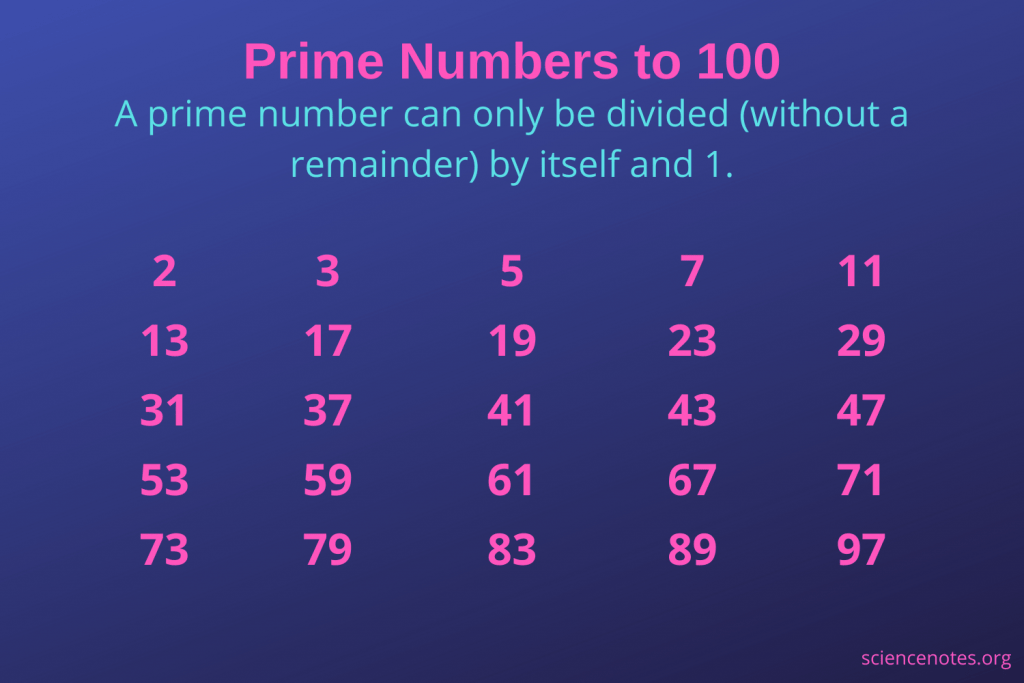
A prime number is a natural number that can only be divided, without a remainder, by itself and 1. In other words, a prime number has exactly two factors. For example, 13 is only divisible by 13 and 1. In contrast, a composite number is a natural number that can be divided evenly by any number besides itself and 1. A composite number has more than two factors. For example, 14 is divisible by 1, 2, 7, and 14.
Here is a list of the prime numbers up to 1000 and a look at how to tell if a number is prime.
Interesting Prime Number Facts
- The state of being prime is called primality.
- There are an infinite number of prime numbers.
- Zero and one are not prime numbers.
- Two is the only even prime number.
- Two and three are the only consecutive prime numbers.
- No prime number greater than five ends in 5.
- No prime number ends with 0.
- Goldbach Conjecture: Every even integer greater than 2 can be expressed as the sum of two prime numbers.
- Every prime number greater than 2 and 3 can be represented as 6n+1 or 6n-1.
- Prime Number Theorem: The probability that a number is prime is inversely proportional to its number of digits.
- Lemoine’s Conjecture: Any odd integer greater than 5 can be expressed as the sum of an off prime and an even semiprime. A semiprime is the product of two prime numbers.
Prime Numbers Up to 1000
The smallest prime number is 2, which is also the only even prime number. Here is a table of all the prime numbers up to 1000.
| 2 | 3 | 5 | 7 | 11 | 13 | 17 | 19 | 23 | |
| 29 | 31 | 37 | 41 | 43 | 47 | 53 | 59 | 61 | 67 |
| 71 | 73 | 79 | 83 | 89 | 97 | 101 | 103 | 107 | 109 |
| 113 | 127 | 131 | 137 | 139 | 149 | 151 | 157 | 163 | 167 |
| 173 | 179 | 181 | 191 | 193 | 197 | 199 | 211 | 223 | 227 |
| 229 | 233 | 239 | 241 | 251 | 257 | 263 | 269 | 271 | 277 |
| 281 | 283 | 293 | 307 | 311 | 313 | 317 | 331 | 337 | 347 |
| 349 | 353 | 359 | 367 | 373 | 379 | 383 | 389 | 397 | 401 |
| 409 | 419 | 421 | 431 | 433 | 439 | 443 | 449 | 457 | 461 |
| 463 | 467 | 479 | 487 | 491 | 499 | 503 | 509 | 521 | 523 |
| 541 | 547 | 557 | 563 | 569 | 571 | 577 | 587 | 593 | 599 |
| 601 | 607 | 613 | 617 | 619 | 631 | 641 | 643 | 647 | 653 |
| 659 | 661 | 673 | 677 | 683 | 691 | 701 | 709 | 719 | 727 |
| 733 | 739 | 743 | 751 | 757 | 761 | 769 | 773 | 787 | 797 |
| 809 | 811 | 821 | 823 | 827 | 829 | 839 | 853 | 857 | 859 |
| 863 | 877 | 881 | 883 | 887 | 907 | 911 | 919 | 929 | 937 |
| 941 | 947 | 953 | 967 | 971 | 977 | 983 | 991 | 997 |
Is 1 a Prime Number?
The number 1 is not usually considered a prime number. It’s also not a composite number.
- 1 is not a prime number because it does not have exactly two positive factors.
- 1 is not a composite number because it does not have more than two factors.
Note: There are some people who argue 1 is a prime number because it’s divisible by itself and 1 (even though these two values are the same thing).
How to Tell If a Number Is Prime
There are a few different ways to tell whether or not a number is prime. The methods are called primality tests, even though some of them actually test whether a number is composite.
Basically, you test whether a number n is evenly divisible by any prime number between 2 and √n. This is called trial division or factorization.
- No prime number ends with 0.
- No even number except 2 is prime. If a number ends with 0, 2, 4, 6, or 8, it’s a composite number.
- If the sum of the digits of a number are divisible by 3, it’s a composite number. A prime number can end with 3.
- No prime number ends with 5, except 5.
- If a number passes all of these tests, check to see if it’s divisible by prime numbers smaller than it. It’s not necessary to check prime numbers greater than √n. Start with 3, 5, 7, 11, and work your way up to √n.
- Check whether or not a number can be expressed as either 6n+1 or 6n-1. For example, the prime number 11 can be written as 6(2)-1.
Examples: Finding a Prime Number Using Factorization
Example 1:
- Is 15874 prime?
- Right away, you can see it’s not prime because it ends with an even number.
Example 2:
- Is 26577 a prime number?
- It does not end in 0, 2, 4, 6, 8.
- The sum of the digits 2 + 6 + 5 + 7 + 7 = 27.
- 27 is divisible by 3, so 26577 is not prime.
Example 3:
- Is 103 a prime number?
- It does not end in 0, 2, 4, 6, 8.
- It does not end in 5.
- The sum of the digits 1 + 0 + 3 = 4. It is not divisible by 3.
- The √103 is ~10.14. So, check to see if 103 is divisible by other primes under 10.
- 103 is not evenly divisible by 7.
- 103 is a prime number!
What Is the Largest Prime Number?
There are an infinite number of prime numbers, so computers discover new primes (slowly, because it takes a lot of computing power). To date, the largest prime number is 282,589,933-1. The Great Internet Mersenne Prime Search (GIMPS) found this prime on December 7, 2018.
References
- Adler, Irving (1960). The Giant Golden Book of Mathematics: Exploring the World of Numbers and Space. Golden Press.
- Crandall, Richard; Pomerance, Carl (2005). Prime Numbers: A Computational Perspective (2nd ed.). Springer. ISBN 0-387-25282-7.
- Dudley, Underwood (1978). “Section 2: Unique factorization“. Elementary Number Theory (2nd ed.). W.H. Freeman and Co. ISBN 978-0-7167-0076-0.
- “GIMPS Project Discovers Largest Known Prime Number: 282,589,933-1“. Mersenne Research, Inc.
- Ziegler, Günter M. (2004). “The great prime number record races”. Notices of the American Mathematical Society. 51 (4): 414–416.
Copyright Disclaimer Under Section 107 of the Copyright Act in 1976; Allowance is made for “Fair Use” for purposes such as criticism, comment, news reporting, teaching, scholarship, and research.
Fair use is a use permitted by copyright statute that might otherwise be infringing. Non-profit, educational or personal use tips the balance in favor of fair use.
All rights and credit go directly to its rightful owners. No copyright infringement intended.
 ukhomeschool