
alliteration
Alliteration Examples: Meaning and Everyday Use
Alliteration is a literary device in which a series of words begin with the same consonant sound. It’s used to emphasize something important that a writer or speaker would like to express. Take a look at these alliteration examples, and explore how they affect the sentence.
How to Identify Alliteration
The best way to spot alliteration in a sentence is to sound out the sentence, looking for the words with identical beginning consonant sounds. Alliterative words don’t have to start with the same letter, just the same initial sound. They can also be interrupted by small, non-alliterative words.
For example, “James and the Giant Peach” is still an example of alliteration, even though it uses both “j” and “g” and includes the words “and” and “the.” Read through these sentences to help you identify alliteration.
- Becky’s beagle barked and bayed, becoming bothersome for Billy.
- Can you keep the cat from clawing the couch? It’s creating chaos.
- Dan’s dog dove deep in the dam, drinking dirty water as he dove.
- Fred’s friends fried fritters for Friday’s food.
- Greedy goats gobbled up gooseberries, getting good at grabbing the goodies.
- Hannah’s home has heat now, hopefully.
- Jackrabbits jump and jiggle jauntily.
- Kim’s kid kept kicking like crazy.
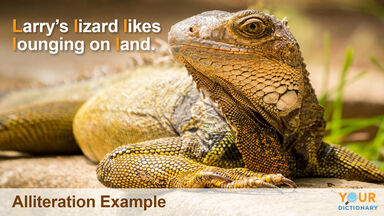
- Larry’s lizard likes lounging on the land.
- Mike made mellow music with his new microphone.
- Nick’s nephew needed some new notebooks.
- Peter’s piglet pranced priggishly.
- Quincy’s quilters quit quilting quickly.
- Rudolph the red-nosed reindeer rose rapidly into the air.
- Seven sisters slept soundly on the sand.
- Tim took tons of tools to make toys for the tots.
- Vivien is very vixen-like and vexing.
- While walking wearily I wondered where Wally was.
- Yarvis yanked his ankle at yoga, and Yolanda yelled out in surprise.
- Zachary zeroed in on zookeeping as a career.
Some of these sentences might sound like tongue twisters to you. In fact, tongue twisters often use alliteration to try and trip readers up (such as “Peter Piper picked a peck of pickled peppers”).
Alliteration in Brand Names
Companies use the alliterative effect all the time. Think of all of the famous and well-known brands and companies that have used alliteration in their names.
- Bed Bath & Beyond
- Best Buy
- Chuck E. Cheese
- Coca-Cola
- Dunkin’ Donuts
- Krispy Kreme
- LifeLock
- Lulu Lemon
- Park Place
- PayPal
The major reason companies use alliteration is to ensure their brand name is memorable. The human brain likes the repetition of alliteration, making it easier to store in your memory.
Alliteration in Famous Names
There are probably some fictional characters or public figures that stand out in your head as a result of the alliterative effect of their name.
Examples of famous alliterative names include:
- Donald Duck
- Fred Flintstone
- Jesse Jackson
- Katie Couric
- Kim Kardashian
- Lois Lane
- Luna Lovegood
- Marilyn Monroe
- Mickey Mouse
- Peter Parker
- Ronald Reagan
- Ryan Reynolds
- Sammy Sosa
- Spongebob Squarepants
- William Wordsworth
An alliterative name can help you stand out in the crowd and make you more memorable. Many examples of alliteration for kids include characters with alliterative names.
Alliteration in Phrases and Quotes
Many well-known phrases, quotes and sayings also make use of alliteration. It’s quite common in conversational idioms that you hear every day.
- busy as a bee
- dead as a doornail
- get your goat
- give up the ghost
- good as gold
- home sweet home
- last laugh
- leave in the lurch
- mad as a March hare
- make a mountain out of a molehill
- method to the madness
- neck and neck
- nervous nelly
- pleased as punch
- primrose path
- right as rain
- ride roughshod
Like alliterative company names and proper names, alliteration in common sayings helps to make them memorable. “Right as rain” is much more fun to say than “totally right!”
Like alliterative company names and proper names, alliteration in common sayings helps to make them memorable. “Right as rain” is much more fun to say than “totally right!”
Examples of Alliteration Poems
Alliteration is a literary device that repeats a speech sound in a sequence of words that are close to each other. Alliteration uses consonant sounds at the beginning of a word to give stress to its syllable. This technique plays a crucial role in poetry by lending a strong rhythm and musical structure to any verse. Explore a few famous alliteration poems to see examples of this technique.
Alliteration is a poet’s tool to bring words together and make patterns in their writing. Several great poets used alliteration in their work. See a few of the greats like William Shakespeare and Edgar Allan and their use of alliteration.
Sonnet 5 by William Shakespeare
William Shakespeare’s work frequently featured alliteration. There are several examples in Romeo and Juliet, but his poetry often used alliteration too. For example, in “Sonnet 5,” the “b” sound in beauty, bareness and bereft set a romantic tone. In the last line, the “s” substance and sweet provides a soothing rhythm.
“Beauty o’er-snowed and bareness every where:
Then were not summer’s distillation left,
A liquid prisoner pent in walls of glass,
Beauty’s effect with beauty were bereft,
Nor it, nor no remembrance what it was:
But flowers distilled, though they with winter meet,
Leese but their show; their substance still lives sweet.”
The Raven By Edgar Allan Poe
“The Raven” by Edgar Allan Poe uses alliteration in word pairs. In the first three lines of The Raven, there are three examples: weak/weary, quaint/curious and nodded/nearly napping.
“Once upon a midnight dreary, while I pondered, weak and weary,
Over many a quaint and curious volume of forgotten lore—
While I nodded, nearly napping, suddenly there came a tapping,”
Birches by Robert Frost
“Birches” by Robert Frost repeats the “b” sound throughout the first four lines to emphasize the dominant theme of the poem.
“When I see birches bend to left and right
Across the lines of straighter darker trees,
I like to think some boy’s been swinging them.
But swinging doesn’t bend them down to stay”
Much Madness is divinest Sense by Emily Dickinson
“Much Madness is divinest Sense” by Emily Dickinson uses alliteration of the “m” sound in the title. This is repeated in the poem itself to encourage readers to contemplate what it means to be mad.
“Much Madness is divinest Sense –
To a discerning Eye –
Much Sense — the starkest Madness –
‘Tis the Majority
In this, as All, prevail –
Assent – and you are sane –
Demur – you’re straightway dangerous –
And handled with a Chain -”
Alliteration is a creative tool that gives all types of poetry a memorable rhythm when recited. It’s a fun way to play with words that brings out the imagination of both writer and reader while appealing to children and adults alike.
 ukhomeschool