
https://sites.pitt.edu/~dash/folktexts.html
What are myths and folktales?
Folktales are stories with people as main characters that sometimes include feats of strength. Myths are stories told to explain the world around us, from the origin of the world, to why there are seasons
Fables, Folktales, Myths and Legends: Overview
Much can be learned about a given culture or society by the stories it tells. These stories often come in the form of fables, folktales, myths, and legends. Such stories have roots in oral storytelling, which are written down or captured on paper long after their genesis. As such, they are often amended and change over time, shifting in their particulars and emphases according to the values of those who are telling them. While fables, folktales, myths and legends are all interesting ways to learn about the cultures they represent, there are several key ways each one of them differ in nature and purpose. These stories not only provide insight into the cultures which create them, but also endless entertainment value.
What are Fables?
Fables, which usually feature animals with human characteristics, contain a moral lesson. Such tales were often used to explore man’s follies or weaknesses in order to instill valuable ethical and moral lessons in their listeners or readers.
Origin of Fables
The first documented volume of fables was Aesop’s Fables in 4th Century Greece. As with folktales, myths, and legends, Aesop likely was recording what had been oral stories up until then. Over time, Aesop’s original collection, which featured around 200 stories, grew larger with later editions. The word “fable” stems from the Latin “fabula” or “story.” Fables achieved great popularity during the Middle Ages, where they, along with allegories (human stories about moral lessons with abstract concepts like Good and Evil as characters), were used by the Catholic Church as an instructional tool. Mare de France issued a large volume of fables in the 12th Century, which popularized what was called the beast epic, or a longer story featuring a popular animal figure. Fables experienced a new burst of popularity in 1668 with the publication of Jean de la Fontaine’s Fables, and again in the 19th Century as writers Like Hans Christian Anderson, Lewis Carol, and Rudyard Kipling incorporating fables in their work. A longer, more modern fable is George Orwell’s 1945 Animal Farm, a work of social and political satire.
.
Features of Fables
Common features of fables include:
- Usually shorter, can be rendered in verse or prose.
- Feature animal characters or inanimate objects with human characteristics (or anthropomorphism).
- Relate a firm moral lesson to be learned at the end.
- Explore human folly or weakness and its consequences.
- Offer a twist or surprising ending that nails the moral lesson.
- Differ from parables, which teach similar moral lessons, but involve human characters.
Fables Examples
 |
- One of Aesop’s most popular fables is that of “The Ant and the Grasshopper.” The Grasshopper, who spends his time and efforts performing his music through the summer, watches as the Ant carefully works to store away food for the impending winter. When fall arrives, the Grasshopper, who has wasted his summer, finds himself with nothing while the Ant has saved enough to feed his family. The fable instills the lesson that one cannot spend one’s days frivolously now without thinking of future hardship.
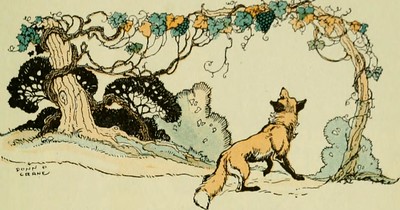
- Another popular fable is that of the “Fox and the Grapes.” The Fox encounters a particularly tantalizing bunch of grapes that is just out of reach. He employs various tactics to reach the grapes, but is unable to. At the end, he convinces himself that the grapes are sour and unappetizing and wanders away still hungry (thus the origin of the phrase of “sour grapes”).
What are Folktales?
Like fables, folktales usually have their beginnings in purely oral tales that change throughout time. They can be long or short, simple, or complex. The stories usually involve people, but can also involve animals as characters who interact with the humans. As they evolve, the tales are often in flux, changing to reflect the perspective and preferences of the person or culture telling them.
Origin of Folktales
The stories of folktales have existed in every culture since man first began telling stories, thus every culture has its own version of folklore that varies according to geography, moral and belief system, and characters. The term “folklore” comes from the melding of “folk” meaning “popular” and “lore” meaning “instruction.” While folktales can be instructive, they are just as often not, which makes them different in nature from fables. Folktales that involve anthropomorphic animals with morals or lessons in the tale can also be hard to distinguish from fables.
Features of Folktales
There are several key elements that define folktales in general throughout all cultures:
- The characters are usually human, though can interact with animal anthropomorphic characters or inanimate objects as in fables.
- Stories and narratives change and travel across cultures, taking on new elements and discarding others. Tales can also change as they are passed on from generation to generation.
- Fantastical elements are often present. These include mythical creatures (fairies, unicorns, dragons), supernatural elements, magic, witches, and tricksters.
- The settings for such stories are often indeterminate or vary in location according to who is telling them.
- The events can be, at times, sexually explicit and/or violent, as in Grimm’s Fairy Tales or The Arabian Nights, which are two popular volumes of folktales.
Fables vs. Folktales
While their methods of transmission via oral storytelling are similar, fables and folktales have key differences. While the characters in fables are always anthropomorphic animals or inanimate objects, folklore usually involves human characters as their focus. While fables are always instructional with a clear moral story and lesson to be learned, folktales can be more ambiguous and not as easily detected, or may, in fact, have no moral lesson at all.
Folktales Examples
- A popular folktale from Westward Expansion in America, “Sally Ann Thunder Ann Whirlwind” tells of a character whose tales involve many outrageous and fantastical elements, including a hat made of bees and an ability to wrestle alligators. Davy Crocket, her alleged husband, was based on a real historical figure (and may therefore qualify as a legend, as seen in the next segment). However, there is no record that Sally Ann Thunder existed beyond the stories about her, which is what renders her stories as a folktale.
- Another popular folktale, “Stone Soup” involves a community suffering famine. A starving family begins to try to make soup out of stones. As other members of the community pass by, they offer to add to the soup what little they have, such as an onion. a carrot. and a single chicken. Soon, by the means of the whole community working together, they have a created a filling soup. The lesson of this particular folktale is that group efforts yield far more rewards than any single individual’s effort.
What are Myths?
Unlike fables and folktales, myths are usually rooted in a single belief system, involving characters and concerns particular to that system. Often myths are offered as an explanation for certain things that were otherwise unexplained. The classical myths of the Greeks and Romans are the most popular examples, but every belief system worldwide has their own myths that give context and explanation to ordinary things like the changes of light/dark, the seasons, or the existence of certain natural phenomena.
Origin of Myths
Like fables and folktales, myths also have their roots in oral storytelling that adapted over time. The Greeks and Romans captured their own with volumes like Hesiod’s Theogony and Ovid’s Metamorphoses. Myths, however, existed in ancient Sumerian and Egyptian theologies as well, pre-dating the western world, and dating back to nomadic tribes who captured them in elaborate cave paintings. Taking their name from “mythos” (or “story of people”) and “logos” (“word of speech”), myths filled the role of explaining certain natural, historical or psychological subject matter.
https://classroom.thenational.academy/lessons/myths-and-folktales-6cwk0c


 ukhomeschool