
book file
Oliver Twist
Introduction
Oliver Twist by Charles Dickens is a great novel to teach to KS3 students, with its colourful characters and dramatic plot.
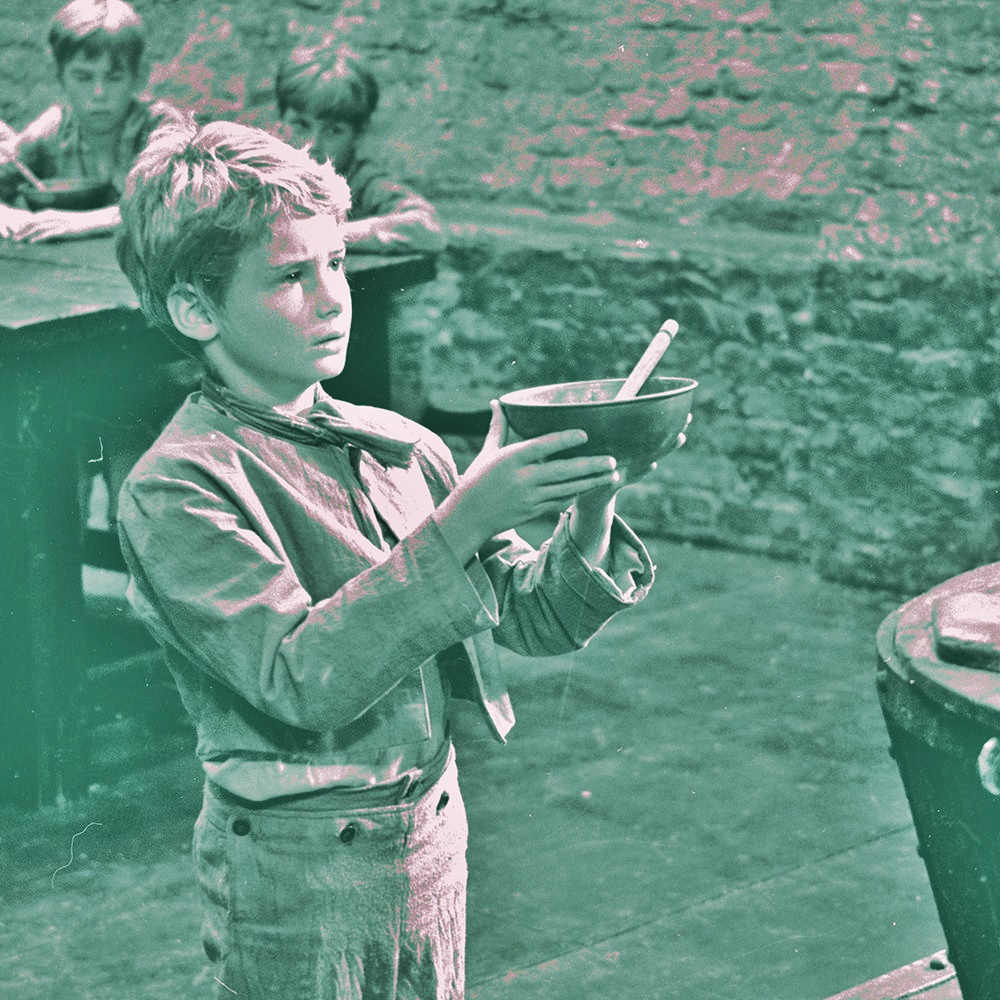
Oliver Twist is the story of a poor boy, born in a workhouse (government institutions for the poor), who throughout the novel bounces between good and bad fortune. In this novel, Dickens highlights some of the terrible injustices of the time, as he saw them, including ‘baby farms’, where poor orphans were kept at government expense, and suffered high death
rates, and the workhouse, where the young Oliver famously asks for more food (and gets horribly punished for his troubles).
It is Oliver’s bad fortune to fall into company with a gang of thieves when he runs away to London, led by Fagin. Near the end of the novel, Fagin is arrested, tried, and sentenced to be hanged. The execution is to be public. Charles Dickens himself attended one or two public executions. For a while he took a position against the death penalty, although he altered that later in life. However, he remained firmly against public executions. The last public hanging in England took place in 1868, and the last judicial hanging in 1964. The death penalty was abolished for murder in most of Britain in 1969, and thereafter for other offenses gradually (for example spying in 1981) until a final abolition in 1998.
The passage you are going to read (from chapter 52) describes a visit to New gate prison by Oliver Twist and his benefactor, Mr Brownlow. They are there to see Fagin, and to ask him a question, the night before his execution.
Exercise 1
Read the passage, then note 3 adjectives to describe how you think Fagin feels at this time.
1 “This,” said the man, stopping in a gloomy passage where a couple of workmen were
2 making some preparations in profound silence – “this is the place he passes through. If you
3 step this way, you can see the door he goes out at.”
4 He led them into a stone kitchen, fitted with coppers for dressing the prison food, and
5 pointed to a door. There was an open grating above it, through which came the sound of
6 men’s voices, mingled with the noise of hammering, and the throwing down of boards. They
7 were putting up the scaffold.
8 From this place, they passed through several strong gates, opened by other turnkeys
9 from the inner side; and, having entered an open yard, ascended a flight of narrow steps,
10 and came into a passage with a row of strong doors on the left hand. Motioning them to
11 remain where they were, the turnkey knocked at one of these with his bunch of keys. The
12 two attendants, after a little whispering, came out into the passage, stretching themselves as
13 if glad of the temporary relief, and motioned the visitors to follow the jailer into the cell. They
14 did so.
15 The condemned criminal was seated on his bed, rocking himself from side to side, with a
16 countenance more like that of a snared beast than the face of a man. His mind was
17 evidently wandering to his old life, for he continued to mutter, without appearing conscious of
18 their presence otherwise than as part of his vision.
19 “Good boy, Charley – well done – “ he mumbled. “Oliver, too, ha! ha! ha! Oliver too –
20 quite the gentleman now – quite the – take that boy away to bed!”
21 The jailer took the disengaged hand of Oliver; and, whispering to him not to be alarmed,
22 looked on without speaking.
23 “Take him away to bed!” cried Fagin. “Do you hear me, some of you? He has been the –
24 the – somehow the cause of all this. It’s worth the money to bring him up to it – Bolter’s
25 throat, Bill; never mind the girl – Bolter’s throat as deep as you can cut. Saw his head off!”
26 “Fagin,” said the jailer.
27 “That’s me!” cried the Jew, falling, instantly, into the attitude of listening he had assumed
28 upon his trial. “An old man, my Lord; a very old, old man!”
29 “Here,” said the turnkey, laying his hand upon his breast to keep him down. “Here’s
30 somebody wants to see you, to ask you some questions, I suppose. Fagin, Fagin! Are you
31 a man?”
32 “I shan’t be one long, he replied, looking up with a face retaining no human expression
33 but rage and terror. “Strike them all dead! What right have they to butcher me?”
34 As he spoke he caught sight of Oliver and Mr Brownlow. Shrinking to the furthest corner
35 of the seat, he demanded to know what they wanted there.
36 “Steady,” said the turnkey, still holding him down. “Now, sir, tell him what you want.
37 Quick, if you please, for he grows worse as the time gets on.”
38 “You have some papers,” said Mr Brownlow advancing, “which were placed in your
39 hands, for better security, by a man called Monks.”
40 “It’s all a lie together,” replied Fagin. “I haven’t one – not one.”
41 “For the love of God,” said Mr Brownlow solemnly, “do not say that now, upon the very
42 verge of death; but tell me where they are. You know that Sikes is dead; that Monks has
43 confessed; that there is no hope of any further gain. Where are those papers?”
44 “Oliver,” cried Fagin, beckoning to him. “Here, here! Let me whisper to you.”
45 “I am not afraid,” said Oliver is a low voice, as he relinquished Mr Brownlow’s hand.
46 “The papers,” said Fagin, drawing Oliver towards him, “are in a canvas bag, in a hole a
47 little way up the chimney in the top front-room. I want to talk to you, my dear. I want to talk
48 to you.”
49 Yes, yes,” returned Oliver. “Let me say a prayer. Do! Let me say one prayer. Say only
50 one, upon your knees, with me, and we will talk till morning.”
51 “Outside, outside,” replied Fagin, pushing the boy before him towards the door, and
52 looking vacantly over his head. “Say I’ve gone to sleep – they’ll believe you. You can get
53 me out, if you take me so. Now then, now then!”
54 “Oh! God forgive this wretched man!” cried the boy with a burst of tears.
55 “That’s right, that’s right,” said Fagin. “That’ll help us on. This door first. If I shake and
56 tremble, as we pass the gallows, don’t you mind, but hurry on. Now, now, now!”
57 “Have you nothing else to ask him, sir?” inquired the turnkey.
58 “No other question,” replied Mr Brownlow. “If I hoped we could recall him to a sense of
59 his position – “
60 “Nothing will do that, sir,” replied the man, shaking his head. “You had better leave him.”
61 The door of the cell opened, and the attendants returned.
62 “Press on, press on,” cried Fagin. “Softly, but not so slow. Faster, faster!”
63 The men laid hands upon him, and disengaging Oliver from his grasp, held him back. He
64 struggled with the power of desperation, for an instant; and, then sent up cry upon cry that
65 penetrated even those massive walls, and rang in their ears until they reached the open
66 yard.
67 It was some time before they left the prison. Oliver nearly swooned after this frightful
68 scene, and was so weak that for an hour or more, he had not the strength to walk.
69 Day was dawning when they again emerged. A great multitude had already assembled;
70 the windows were filled with people, smoking and playing cards to beguile the time; the
71 crowd were pushing, quarreling, joking. Everything told of life and animation, but one dark
72 cluster of objects in the center of all – the black stage, the cross-beam, the rope, and all the
73 hideous apparatus of death.
Exercise 2
1. Fagin notices Oliver in lines 19-20, and remarks at how good he looks. True or false?
2. Why does Fagin approve of Oliver’s tears in line 55?
3. Why does Dickens refer to the gallows as ‘the black stage’ in line 72?
4. The word ‘turnkey’ appears twice in the third paragraph (lines 8 – 14). Breaking the word into its two parts, and thinking of where this scene is, what other word in the paragraph has the same meaning?
5. Look at ‘beguile’ in line 70. Are the crowds there to smoke and play cards, or for a later ‘attraction’? What word do you think you could put in place of ‘beguile’?
https://www.twinkl.co.uk/teaching-wiki/oliver-twist
https://wordmint.com/public_puzzles/243219
 ukhomeschool