
EARLY LIFE
- Enid Blyton was born on August 11, 1897, in East Dulwich, South London.
- She was the eldest child among the three children of Thomas Carey Blyton, a cutlery salesman, and Theresa Mary Harrison.
- Thomas, her father, influenced Enid’s love for nature, gardening, art, music, literature, and theatre.
- Enid described Thomas in her biography as a man who “loved flowers and birds and wild animals, and knew more about them than anyone I had ever met”.
- Enid’s mother had little concern towards her passion.
- After Enid turned thirteen, Thomas left to live with another woman.
- This event devastated Enid.
- For the rest of her life, Enid and her mother did not have a good relationship.
EDUCATION
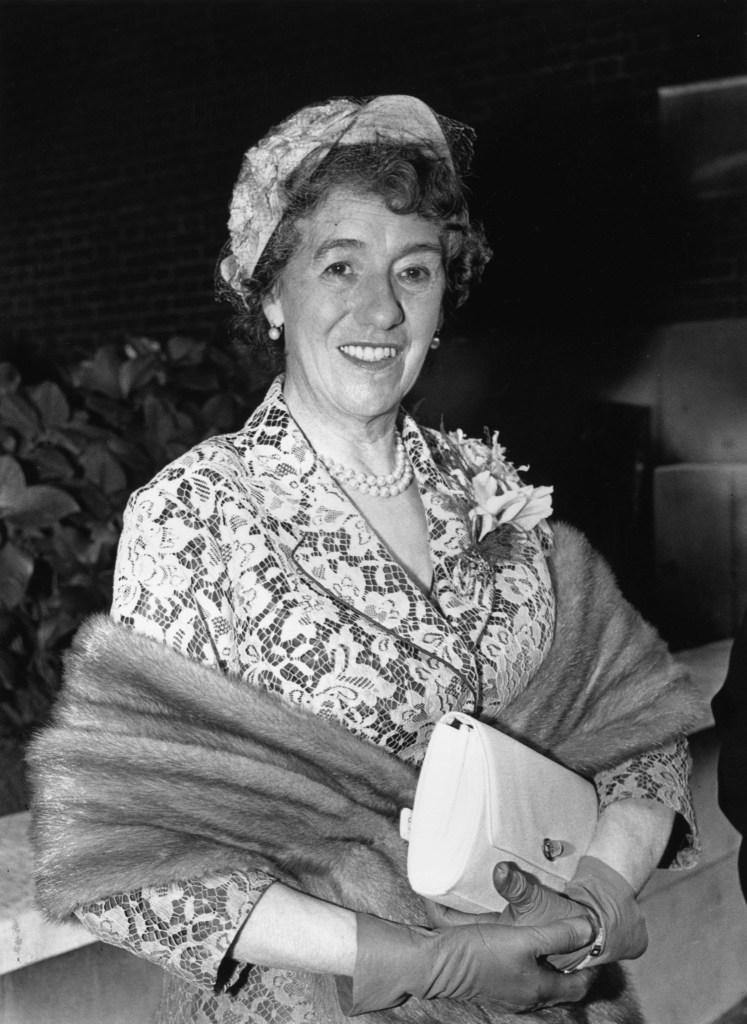
- Enid attended St Christopher’s School in Beckenham from 1907 to 1915.
- While studying in Beckenham, Blyton enjoyed physical activities. She became the school tennis champion, and captain of lacrosse.
- In 1911, Enid entered Arthur Mee’s children’s poetry competition.
- Arthur Mee, a respected journalist and author, offered to print Blyton’s verses and encouraged her to write more.
- However, her antagonistic mother thought that writing was just a waste of time.
- Nonetheless, Blyton found encouragement from people far from relatives. One was Mabel Attenborough, aunt of Mary Potter, Blyton’s friend from school.
- Blyton was supposed to enroll at the Guildhall School of Music, but instead responded to her calling as a writer.
- Blyton moved out of the family home in 1915. She lived with Mary Attenborough.
- Later on, she stayed with George and Emily Hint at Seckford Hall, Suffolk.
- Ida Hunt, a friend Blyton met at Woodbridge Congregational Church, suggested that Blyton trained as a teacher at Ipswich High School, where Hunt was also teaching.
- In September 1916, Blyton enrolled at the National Froebel Union for a teacher training course.
- While studying teaching, Blyton wrote and passed manuscripts to publishers. This was the time when Blyton got her first rejections.
- Blyton seemed to have a determined soul, as rejection only pushed her to be better.
- She said in her autobiography: “it is partly the struggle that helps you so much, that gives you determination, character, self-reliance – all things that help in any profession or trade, and most certainly in writing”.
- Blyton completed her training course in December 1918.
TEACHING CAREER
- In January 1919, Blyton was appointed as a teacher at Bickley Park School, where she taught small boys.
- In 1920, Blyton moved to Southernhay in Hook Road, Surbiton. There, she served as a nursery governess to the four sons of architect Horace Thompson and his wife Gertrude.
- Blyton served the family happily for four years.
WRITING CAREER
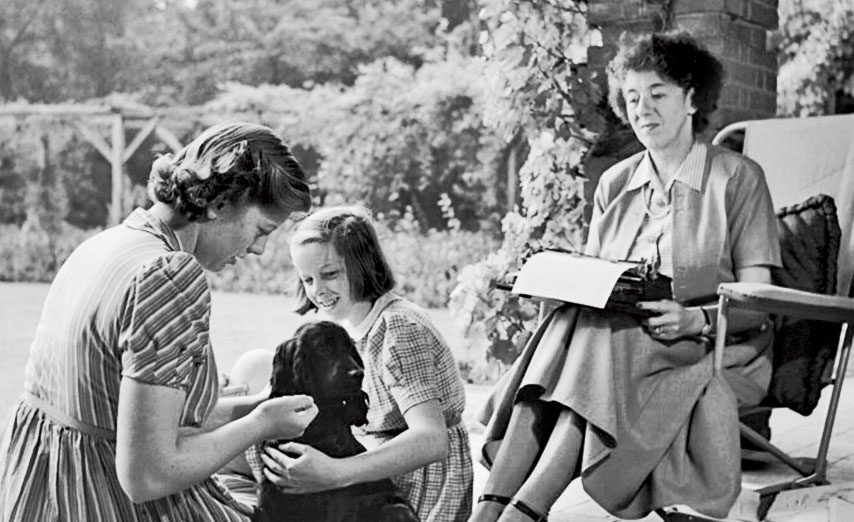
- Blyton relocated to Chessington in 1920, where she wrote in her spare time.
- In 1921, she received her first award as she won the Saturday Westminster Review writing competition. Her winning piece was an essay titled “On the Popular Fallacy that to the Pure All Things are Pure”.
- Her first victory gave her notoriety to respected publications, such as The Londoner, Home Weekly, and The Bystander, that showed interest in her short stories and poems.
- In 1922, Blyton published her first book, Child Whispers, a 24-page collection of poems.
- Child Whispers was illustrated by Phyllis Case, Blyton’s school friend.
- Phyllis had already collaborated with Blyton on her early works.
- Also in 1922, Blyton began writing annual pieces for publishers Cassell, and George Newnes.
- “Peronel and his Pot of Glue” was also accepted for publication in Teacher’s World.

COMMERCIAL SUCCESS
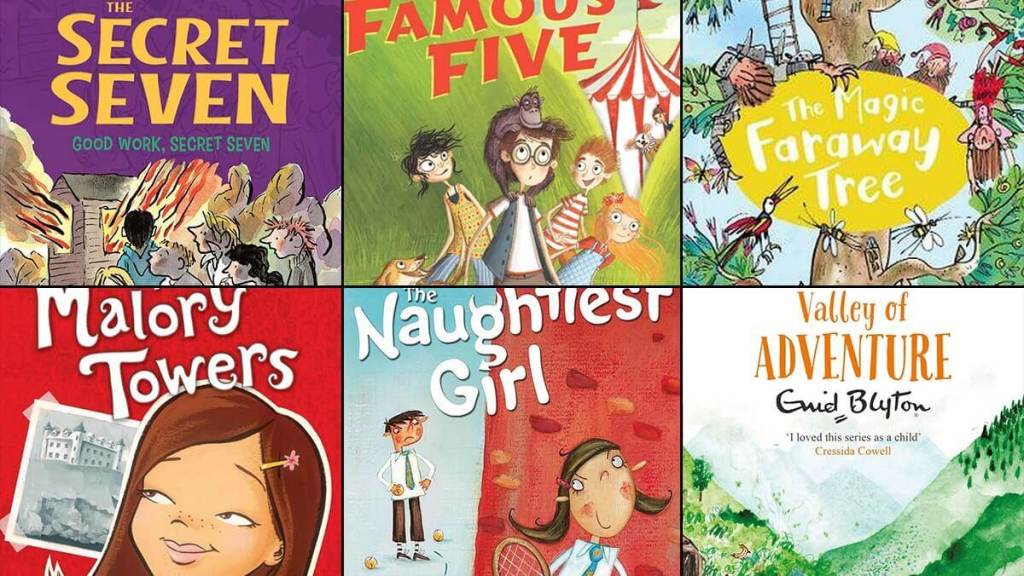
- The Talking Teapot and Other Tales, the first book in the Old Thatch series of twenty-eight books, was published in 1934.
- Adventures of the Wishing-Chair was Blyton’s first serial story and first full-length book, and was published in 1937.
- The Secret Island was her first full length adventure novel, and was published in 1938.
- The Enchanted Wood, the first book in the Faraway Tree series, was published in 1939.
- In 1942, Blyton published the first book in the Famous Five series, her most notable work.
- The first Secret Seven novel was published in 1949.
- Noddy, one of her most known characters, first appeared on June 5, 1949 in Sunday Graphic.
DEATH
- Blyton became increasingly ill in 1968. She died on November 28, 1968, aged 71, at the Greenways Nursing Home, Hampstead, North London.
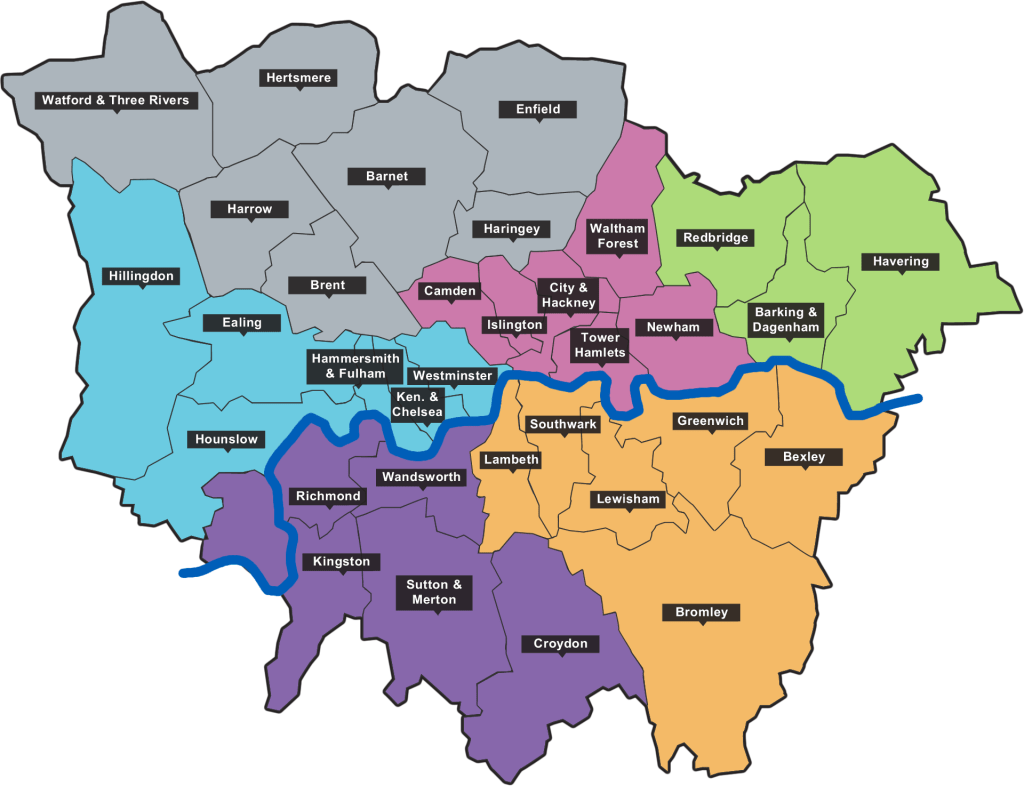
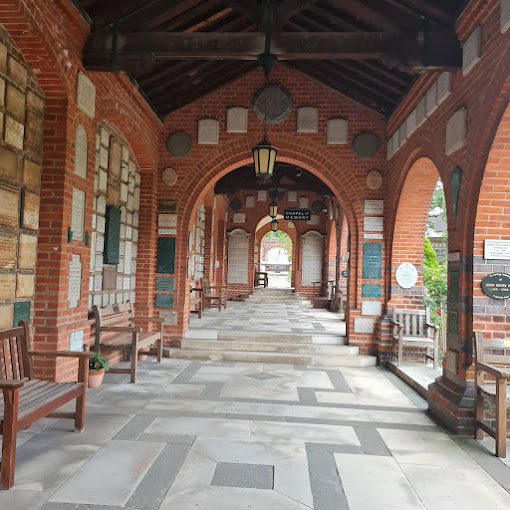
Enid Blyton was cremated after her death
Golders Green Crematorium, London
https://www.purposegames.com/game/enid-blyton-books
You could have your child create their own Famous Five character masks, or they could make a map of Kirrin Island, or they could build a replica of Kirrin Cottage with some cardboard and other craft materials. As for reading and writing, they could keep a journal as if they were one of the Famous Five characters, or you could have them write their own version of one of the stories.
ask them some questions about the books, like why they think the characters behaved the way they did, or what might happen next in the story. You could also ask them to make predictions about what might happen, and then see if their predictions are correct
One idea could be to ask them to identify the main characters in the story, and then ask them to describe those characters. For example, you could ask them to describe George’s personality. Or you could ask them what they think the main conflict of the story is. Or you could ask them what the resolution of the story is.
You could ask them to identify the point of view from which the story is told. Is it first-person or third-person? You could also ask them to identify the setting of the story, and ask them to describe the atmosphere of the story. You could also ask them how the author uses language to create a specific mood or tone in the story.
draw the main characters and then connect them with lines that show how they are connected to each other. Or you could have them write down a list of the characters’ personality traits, and then have them identify which characters share certain traits.
create a “story map.” A story map is a visual representation of the important elements of a story, like the characters, setting, problem, and solution.
the famous five stories. One idea is to have your child create a collage of images that represent the characters, settings, and events in the story. They could use images from magazines or newspapers, or they could even draw their own images. Another idea is to have them create a “character portrait,” where they draw or paint a portrait of one of the characters. They could also create a “setting scene,” where they draw or paint a scene from the story.
child write their own version of a famous five story. They could take one of the existing stories and retell it in their own words, or they could create a new story that uses some of the same characters and settings. This would be a great way to get them thinking about how stories are constructed, and how they can use their imagination to create something new.
craft activities you could do related to the famous five stories! One idea is to have your child make a “story box.” They could decorate a small box or container to look like one of the settings from the story, and then they could put small objects inside that represent the characters and events in the story. They could also create a “story mobile” by decorating a paper plate with images from the story and hanging it from a string
 ukhomeschool