
Use our wealth of information to help your pupils answer the question, ‘What is a relative pronoun?’. Here you can learn more about the relative pronoun, how it’s used in the English language, and why it’s important for your pupils to understand. We’ll explore a range of examples along with their explanations which you can use with your pupils.
You can use our information and resources to help plan your lessons, or share this information page with your pupils to keep as a reference point. Teach your pupils all about relative pronouns with our range of fantastic teaching resources on this topic.
What is a Relative Pronoun?
A relative pronoun is a word which is used to begin a relative clause, such as ‘who’, ‘that’, ‘whose’, ‘which’, and ‘whom’. To understand and answer the question, ‘What is a relative pronoun?’, we must first understand the relative clause.
Relative Clauses
- A relative clause post modifies (adds extra information about) the subject or object noun phrase in the main clause.
- It is dependent on the main clause, because it only makes sense when paired with one, and can not be used as a stand alone sentence. This is why a relative clause is a type of subordinate clause that is used to describe a noun phrase.
- Relative clauses are optional, as they only add additional information about the subject or object of the main clause.
- Relative clauses can describe people, things (including animals), places, abstract ideas, or just about any noun, as long as they are referring to the subject or object noun phrase contained in the main clause.
Check out the handy video below to help your pupils understand relative clauses.
So, as we now know, it’s the relative clause that holds the extra information about the subject or object noun phrase, and it’s doing all of the work in terms of portraying meaning. The relative pronoun is simply the word that introduces the relative clause, so that listeners or readers know whether the speaker or writer is referring to the subject or object noun phrase from the main clause.
When discussing grammar, lots of linguists use different terminology to refer to the same concept. It’s important to note that relative clauses are also sometimes referred to as adjective clauses because they give us additional information about the subject of the independent clause.
Examples of Relative Pronouns
The relative pronouns that primary pupils will encounter are:
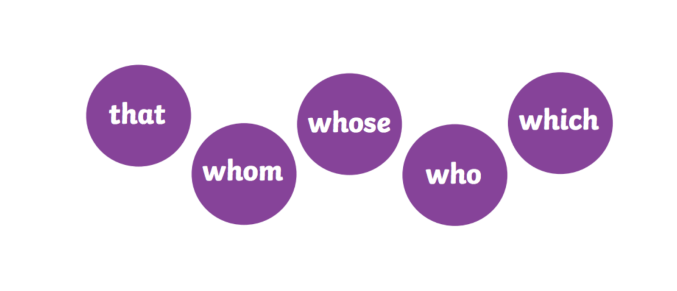
These relative pronouns are usually used in the middle or at the end of sentences to introduce the relative clause. Here are a few examples of relative pronouns used in sentences.
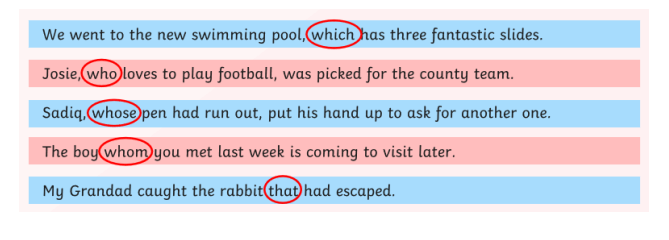
Relative Pronouns: Who
This is used when referring to people in the subject noun phrase. It’s also common to use ‘who’ to refer to the object noun phrase as well, but this didn’t used to be considered standard English.
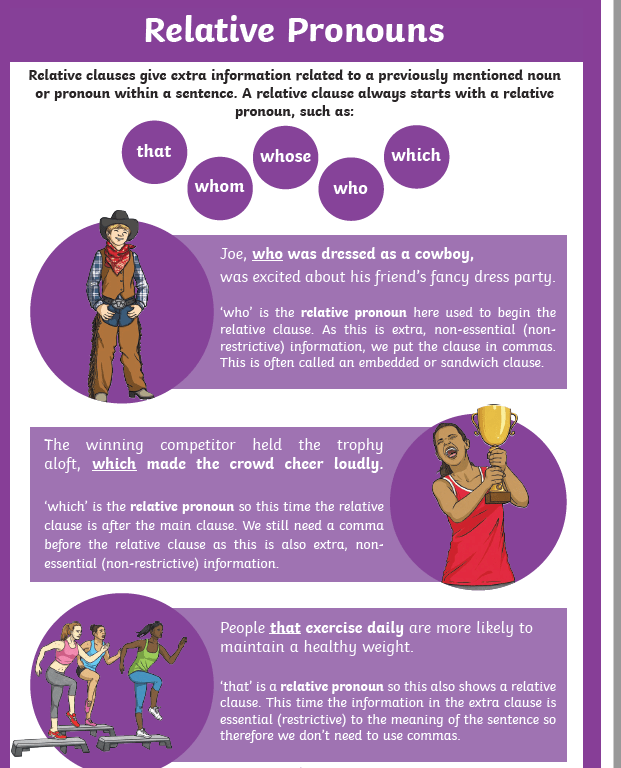
- “Joe, who was dressed as a cowboy, was excited about his friend’s fancy dress party”.
‘Who’ is the relative pronoun here used to begin the relative clause. As this is extra, non-essential (non-restrictive) information, we put the clause in commas. This is often called an embedded or subordinate clause. In this instance, the relative clause is adding extra information about the subject noun phrase, ‘Joe’.
- “Joe baked his Mum a Victoria sponge cake, who was very pleased with her Mother’s Day present”.
‘Who’ is the relative pronoun here, as it introduces the relative clause which functions to add extra information about Joe’s Mum, the object of the sentence. The sentence could make sense without this relative clause, as ‘Joe baked his Mum a Victoria sponge cake’.
Relative Pronouns: That
‘That’ is used as a relative pronoun when referring to people or things.
- “The hat that I was going to buy is now on sale’’.
‘That’ is the relative pronoun that introduces the relative clause, which is adding additional information about the subject noun phrase ‘the hat’. The information is still non-essential, so could make sense as ‘The hat is now on sale’.
- “The paints that I bought are going to be used on wood’’.
‘That’ is the relative pronoun that introduces the relative clause ‘that I bought’, which is used to describe the subject noun phrase, ‘the paints’. This relative clause is non-essential as the sentence could make sense without it as, ‘The paints are going to be used on wood’.
Relative Pronouns: Which
‘Which’ is also used when referring to things.
- “The collar, which was a bit loose, slipped from the dog’s head’’.
‘Which’ is the relative pronoun here, used to add extra information about the subject noun phrase ‘the collar’. As this is non-essential information, the relative clause is inserted into the sentence between commas.
- “The book, which was in terrible condition, was a fantastic read’’.
‘Which’ is the relative pronoun here, introducing the relative clause. It is used to describe the subject noun phrase, ‘the book’, and is non-essential, as the sentence could make sense as ‘The book was a fantastic read’.
Relative Pronouns: Whose
‘Whose’ is the possessive form of ‘who’ and is used when describing the ownership of something or someone by the subject or object noun phrase.
- “The boy, whose Father is a doctor, lives two doors down from me’’.
‘Whose’ is the relative pronoun here because it introduces the relative clause that adds extra information about the subject noun phrase ‘the boy’. ‘Whose’ is a possessive relative pronoun because it is the boy’s Father, so ‘whose’ signifies the ownership of that family relation. This relative clause is non-essential, meaning that the sentence could make sense without it as, ‘The boy lives two doors down from me’.
- “The dog, whose collar was loose, ran away and found his own way home’’.
‘Whose’ is the relative pronoun here, introducing the relative clause, ‘whose collar was loose’. This possessive relative pronoun is used because it’s the dog’s collar which is being discussed, so the dog has ownership of the collar. It is also non-essential, as the sentence could make sense as ‘The dog ran away and found his own way home’.
Relative Pronouns: Where
‘Where’ is used when referring to a place or location.
- “The house, where I grew up, has now been turned into apartment blocks’’.
‘Where’ is the relative pronoun here, because it functions to add extra information about the subject noun phrase ‘the house’. This relative clause is within commas because it adds non-essential information to the sentence, meaning that the sentence could make sense without it. So, the sentence could function without the relative clause as, ‘The house has now been turned into apartment blocks’.
- “I went to the house where I grew up’’.
We can see that the relative clause can be used in a different way, while conveying the same information. So, ‘where’ is the relative pronoun, introducing the non-essential relative clause. The main clause could make sense by itself, as, ‘I went to the house’.
Relative Pronouns: Whom
‘Whom’ is used when adding extra information about the object noun phrase of the main clause. It’s becoming quite archaic, which means that it is coming out of use. It’s not found in American English very much, and is only used in very formal or academic contexts in British English. Pupils don’t need to worry about this one too much, but it’s helpful for them to have an awareness of it for when they come to read older or formal texts.
- “The parents spotted a lady in a suit, whom they assumed to be the head teacher’’.
‘Whom’ is the relative pronoun here, which is used to introduce the relative clause which adds extra information about the object noun phrase ‘a lady’.
- “The dog chased the cat, whom was very afraid’’.
‘Whom’ is introducing the relative clause here, which is adding extra information about the object noun phrase, ‘the cat’.
Relative Pronouns: When
‘When’ is used when referring to a time or time period, and is often used as a relative pronoun in less formal situations.
- “There isn’t a day when I don’t think about it’’.
‘When’ is the relative pronoun here, as it is describing the subject noun phrase ‘a day’. It’s essential information that needs to be present for the sentence to make sense. ‘That’ could also make sense as the relative pronoun here, but ‘when’ is often used in more informal contexts.
Relative Pronouns in the National Curriculum
Children should be introduced to relative pronouns in the context of relative clauses. They should be familiar with relative clauses beginning with ‘who’, ‘which’, ‘where’, ‘when’, ‘whose’, and ‘that’. Understanding the use of relative pronouns and relative clauses will enable your pupils to…
- acquire grammatical terminology that can be used to label the language;
- understand how a sentence can be broken into labelled segments;
- understand how grammar helps to contribute to meaning;
- understand how words are used to join clauses;
- make grammatically correct choices in their written work when deciding which relative pronoun to use;
- understand how punctuation plays a part in the grammatical construction of a sentence.
Understanding the use of relative pronouns and relative clauses will also allow your pupils to adopt a better grammatical understanding of the English language so that they can improve their written work. This will mean that they will be able to correctly use more complex and creative sentence constructions, by having an awareness of how they’re used.
 ukhomeschool